From building facades to immersive stages
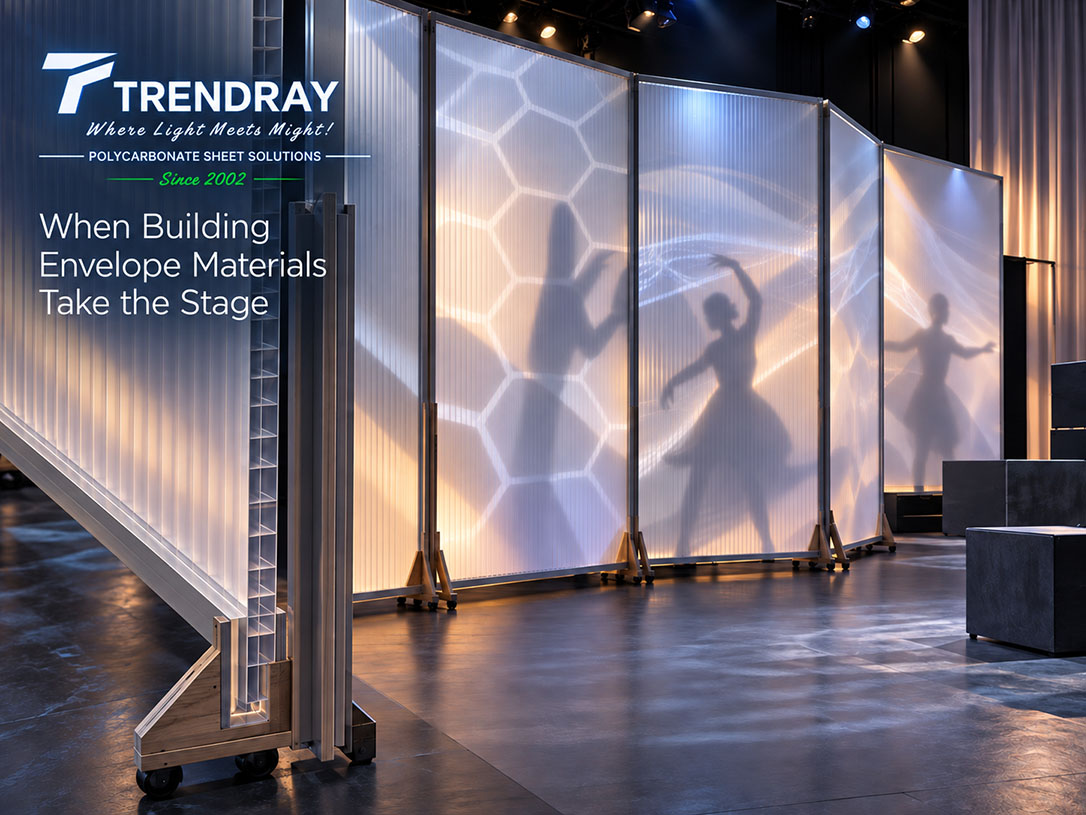
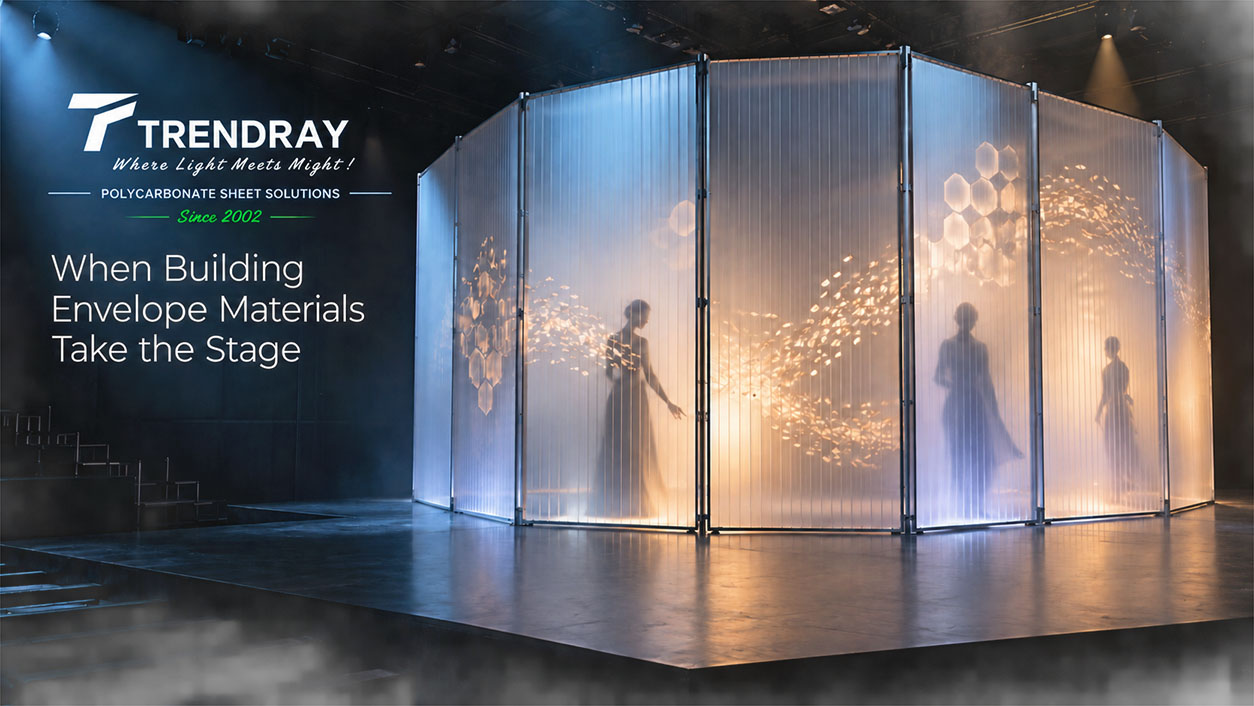
According to Construction Specifier, New Village Arts in Carlsbad, California, brought a high-performance translucent polycarbonate enclosure system into the stage design for the science-fiction play The Apiary. Six large modular panels formed a hexagonal volume that served as a performance space, projection surface, and storytelling element.
The installation used 10 mm clear matte polycarbonate glazing with polycarbonate joining elements. Each module measured approximately 1.83 m wide by 2.4 m high, providing enough room for several actors. As lighting, projections, and performers moved around the panels, the surfaces shifted from veiled opacity to translucency and partial visibility. Animated bee imagery could also travel across the closed enclosure.
Why is polycarbonate board suitable for stage design
Stage scenery often involves a trade-off between visual performance, structural strength, and ease of movement. The low weight of polycarbonate can reduce handling demands for large installations, while its impact resistance suits repeated assembly and close interaction with performers. Translucent or matte surfaces diffuse light and support rear projection, silhouettes, and layered imagery. Standardized connections also allow a large structure to be divided into manageable modules for rehearsals, scene changes, transport, and storage.
The reference project also shows that a permanent building system cannot simply be transferred to the stage without modification. An early aluminum frame proved too heavy, so the engineering team replaced it with a custom wood support structure to reduce weight while maintaining stability. For similar projects, panel thickness, module size, support materials, connections, base stability, and fire-performance requirements should be evaluated against installation height, movement frequency, audience proximity, and applicable venue codes.
More creative space brought by plug-in structure
This type of application is particularly relevant to interlocking polycarbonate panels. Tongue-and-groove or locking edges can create a continuous surface with fewer visible face fixings, helping projections and lighting effects remain visually coherent. Panels can be divided into stage-sized modules and combined with timber structures, aluminum frames, or custom bases to form straight walls, faceted volumes, enclosures, or movable screens. Clear, opal, matte, or custom-colored finishes can be selected, while lighting placement can change the perceived transparency and privacy of the space.
The same design logic can extend beyond theatre to pop-up stores, museum and gallery displays, fashion shows, retail windows, light-art installations, film studios, and reusable exhibition spaces. In these settings, interlocking polycarbonate panels become more than building-envelope components: they act as design surfaces that control light, shape space, and carry projected imagery.
Repeatable construction reduces waste of one-time scenery
Many conventional stage sets are dismantled or discarded after a production closes. In the reference project, the panels were designed as a long-term asset that could be reconfigured for future productions and spaces. The modular nature of interlocking panels supports the same approach: after an event, modules can be removed, stored by size, and arranged differently for the next installation. Durable materials and reversible connections can extend service life and reduce dependence on single-use scenic materials.
Re evaluate the performance of sheet metal from non-traditional demands
This stage application offers a practical lesson for the building-materials industry. Innovation does not always begin with a new material; it can also come from recombining proven properties for a different context. Low weight, impact resistance, light transmission, fabrication flexibility, and modular connections are technical criteria in facade projects. In theatre, exhibitions, and temporary spaces, the same properties translate into mobility, visual performance, and reuse.
For architects, scenic designers, exhibition contractors, and branded-space teams, interlocking polycarbonate panels offer an alternative to glass, fabric, timber boards, and disposable plastic scenery. Their value depends not only on the panel itself, but on how the panels, connection system, support structure, and lighting design work together as one coordinated installation.
TRENDRAY's application support
TRENDRAY can support interlocking polycarbonate and translucent enclosure projects with recommendations on panel profile, thickness, color, surface finish, length, and connection design, together with fabrication, packaging, and modular installation considerations. For non-traditional uses such as stages, exhibitions, and temporary installations, structural loads, support methods, mobility, fire-performance targets, optical effects, and expected assembly cycles should be confirmed early so that the system can be tailored reliably.